
Rethinking Power Struggles: From Control to Connection
Two posts exploring power, love, and the divine image in family life


It’s 3:45 on a weekday afternoon. The backpack hits the kitchen floor with a thud that somehow carries the sound of the whole day’s exhaustion. Alex, a fourth grader, kicks off his shoes and heads straight for the pantry.
“Snack first, then homework, right?” his mom calls, trying to sound casual but already aware of the storm that might be brewing.
Alex grabs a bag of chips, plops onto the couch, and flips on the TV. His mom takes a deep breath—the kind every parent knows—and waits a few minutes. “Alright, bud,” she says gently, “time to get started on that math homework.”
Alex doesn’t even glance up. “I just got home. I need a break.”
“I know,” she replies, “but the sooner you start, the sooner you’re done.”
He groans, mutes the TV, and mutters, “That’s not fair. You get breaks when you work.”
What started as a conversation about homework is now a tug-of-war about control. She steps closer and takes the remote. “Alex, I’m serious. Turn it off. Homework first.”
“Why do you always have to boss me around?” he fires back.
And suddenly the living room transforms into a courtroom: she as the enforcer of order, he as the defender of freedom. No one’s learning math anymore. Both are trying to prove who gets to decide what happens next.
By dinnertime, nothing’s been solved. Alex’s homework is still untouched, and his mom is replaying the argument—wondering how something so ordinary turned into a battle.
Power, but for what?
Moments like these can make our homes feel like small battlegrounds where love and authority, freedom and structure clash. But what if power struggles aren’t really about who wins? What if they’re invitations to see power differently, to shift from control to connection?
That’s the idea I want to explore: the difference between unilateral power and relational power. This distinction has changed not only how I think about parenting but also how I understand God.
The Groundwork: Parenting Styles
Diana Baumrind’s classic research gave us a framework for parenting styles that still shapes developmental psychology today. She described them along two axes: responsiveness (how emotionally attuned we are to our children) and demandingness (how much structure and guidance we provide).
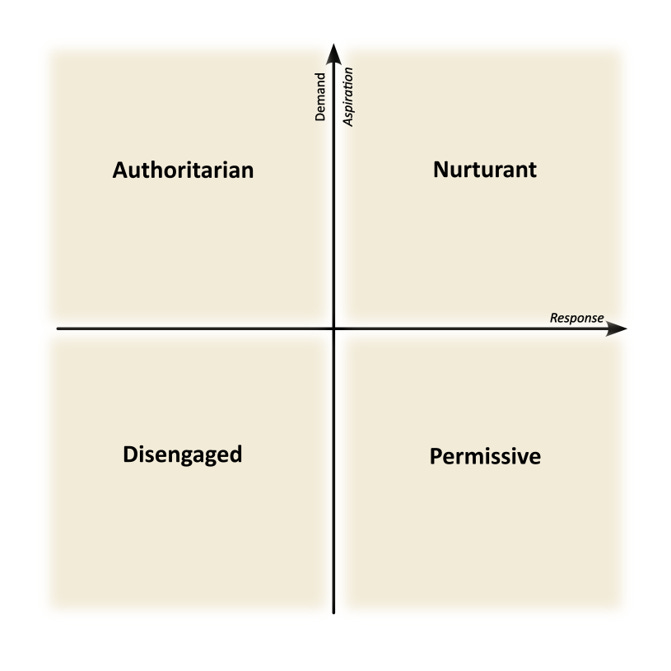
That grid gives us four main styles:
Authoritarian: These parents are highly demanding with less responsiveness. They have high expectations for their children’s performance and adherence to rules. Their children have little input, including family decisions. When their children ask, “Why?” The answer is typically, “Because I said so.”
Permissive: Permissive parents are highly responsive but are less demanding. They highly value their children’s input to the point that the children set the goals rather than the parents. They come across more as friends than parents.
Disengaged: These parents are neither demanding nor responsive because they are not present due to factors like death, divorce, or severe disinterest.
Nurturant: Nurturant parents are very attentive and have high hopes that they steer their children toward. They provide their children with tools to help them adjust and grow as they gradually assume new responsibilities and freedoms. They are interested in providing tools, not just rules, and their children regularly contribute to family life because they feel loved and know their contributions make a difference.
Study after study shows that the nurturant style leads to healthier, more compassionate, and more capable adults.
Baumrind’s original classification used the term “authoritative.” I prefer the term “nurturant” to “authoritative” because it is less confusing and conveys warmth, aspiration, and guidance without implying dominance. These parents still lead and direct—but they do so in relationship, not through demands.
She thought of the vertical axis as a representation of parental “demandingness.” The word “demand” implies an authoritarian approach and represents less responsiveness than is characteristic of the nurturant style. I like to think of nurturant parents as aspiring for their children and guiding them toward those aspirations.
A key difference between insisting on compliance with parental expectations and providing supportive guidance toward parental aspirations is responsiveness. Authoritarian parents who lack responsiveness expect obedience, while nurturant parents who are highly responsive are empowering by default.
If nurturant parenting leads to thriving children, what makes it so different from authoritarian control? The answer lies in how each understands “power.” That’s where Bernard Loomer’s insight offers a new perspective.
Two Conceptions of Power
Loomer, a theologian writing in the mid-1970s, proposed that there are two basic ways people think about power: unilateral and relational.1
Unilateral Power
This is the dominant view in our culture—and in much of theology. Loomer described it as “the ability to produce intended or desired effects in our relationships to nature or to other people.” It aims “to influence, guide, adjust, manipulate, shape, control, or transform the human or natural environment to achieve one’s purposes.” It is one-directional and seeks to influence without being influenced in return. It assumes that the one in power knows what’s best and acts to accomplish that end.
Unilateral power isn’t limited to using coercion; it can also use persuasion. Open and relational theologians sometimes describe divine power as persuasive and never coercive. I think that’s true. However, we should be careful, as persuasion can be used in a unilateral, non-relational way. I think God is always relational and doesn’t use unilateral power either coercively or persuasively.
In this model, power becomes a zero-sum game: one person gains only when another loses. Those who are best at influencing without being influenced can feel a sense of superiority or importance. The result is hierarchy, growing inequality, and divisions.
Relational Power
Loomer provided an alternative. It is bidirectional, meaning “the ability both to produce and to undergo an effect.” It’s a power that recognizes the importance of being influenced by others. In this model, the ability to be influenced by others is seen as a sign of strength and enables influencing others.
Relational power doesn’t assume it already knows the good of the other. It seeks that good together, through mutual understanding and compassion. It seeks the other’s perspective and develops an idea of the true good from “deeply mutual relationships.”
With this idea of mutual relationships in mind, power is not merely the ability to produce an effect or to undergo an effect. Instead, it is the power to sustain a relationship that both influences and is influenced by those involved. The goal is for both parties to grow in their capacity to give and receive within the relationship. Neither seeks to control, manage, or dominate.
Loomer notes that practicing this type of power is difficult and requires patience, stamina, strength, and the possibility of suffering. This sounds a lot like parenting and other relationships worth committing to, such as marriage.
Kathlyn Breazeale gets practical with Loomer’s idea of relational power and applies it to marriage, calling it “mutual empowerment.”2 This idea also fits in other relationships. In my next post, I will examine our relationships with God and with our children.
Bernard Loomer, “Two Conceptions of Power,” Process Studies 6, no. 1 (1976): 5–32.
Kathlyn Breazeale, Mutual Empowerment: A Theology of Marriage, Intimacy, and Redemption (Minneapolis, MN: Fortress, 2008).
image: ChatGPT
This series of two posts comes from a presentation I gave two weeks ago at the Open and Relational Theology pre-session at Theology Beer Camp. Thanks to
and for arranging these events!
Excellent post! I loved this: "persuasion can be used in a unilateral, non-relational way." Much to think about in that.